What is psychoanalysis, and why would movies go there? Psychoanalysis is a form of talking therapy and a framework for ideas. It is composed of three interrelated strands: metapsychology, which is a body of theoretical hypotheses about the nature and structure of the mind, a model of psychological development, and a collection of psychotherapy techniques like dream analysis and free association. Psychoanalysis has also been an inspiration for some of the most famous and thought-provoking films ever made, from the subtle psychological exploration of Bergman’s films to the dark, twisted minds of Hitchcock’s characters.
Hitchcock, The Master of Suspense
 Known for his suspenseful films, Alfred Hitchcock is widely regarded as one of the greatest directors of all time. Perhaps the most well-known aspect of his art is how he incorporated psychoanalytic themes into his pieces. His films, which are renowned for their complex narratives, tense moments, and psychological nuance, have had a profound effect on the film industry.
The psychological depth, intricate storyline, and innovative filmmaking techniques of these Hitchcock films continue to captivate audiences.
1958’s “Vertigo” is regarded as one of Hitchcock’s best films and a masterwork of psychological suspense. The main character of the movie is Scottie Ferguson, a former detective with acrophobia, or a fear of heights. His job is to follow Madeleine Elster, a mysterious woman who seems to be close to taking her own life. As Scottie becomes increasingly obsessed with Madeleine, she tragically dies in a fall. Many years later, Scottie meets Judy Barton, a woman who remarkably resembles Madeleine. He becomes convinced that Judy is Madeleine reincarnated and sets out to recreate their past relationship, leading to a dangerous obsession that threatens his sanity.
Scottie’s obsession with possessing and controlling Madeleine is explored in the film, along with the destructive power of obsession. Additionally, as Scottie’s understanding of what is happening becomes more warped, vertigo makes it harder to distinguish between reality and illusion. Hitchcock also skilfully manipulates the audience’s perception of events by using suggestion to great effect, which adds to the tension and unease. Not to mention, the film’s cinematography is amazing, especially when it comes to the use of vertigo sequences, and Bernard Herrmann’s eerie score greatly adds to the mood and impact of the picture.
Some consider Psycho, which came out in 1960, to be a suspense masterwork. This horror movie is a ground-breaking piece of art that revolutionised the genre. It demonstrated how horror can encompass so much more than just shock and graphic violence. Its exploration of intricate psychological themes, an iconic shower scene, and novel narrative techniques have cemented its place in cinematic history. The movie centres on Marion Crane, a secretary who steals money from her company. Fleeing at a remote motel, she encounters the enigmatic Norman Bates, the motel’s proprietor. As Marion’s stay progresses, she becomes increasingly unsettled by Norman’s strange behaviour and the eerie atmosphere of the motel. A startling turn of events exposes Norman’s actual nature, setting up a terrifying conclusion. To keep viewers on the edge of their seats, Hitchcock expertly combines suspenseful storytelling and shock tactics. A classic illustration of this is the scene in the shower, which blends sudden violence with a voyeuristic viewpoint. Along with examining themes of madness, obsession, and guilt, Psycho also explores the intricacies of the human psyche. These psychological depths are vividly and unsettlingly portrayed by the character of Norman Bates. The movie also has an unusual narrative structure because it gradually reveals important information and switches perspectives. This keeps the audience wondering and evokes a sense of unease. Finally, the use of shadows and cramped areas in the film’s cinematography adds to the eerie atmosphere. The famous soundtrack by Bernard Herrmann heightens the suspense and tension even more.
 Bergman, The Explorer of the Soul
The films of Swedish filmmaker and screenwriter Ingmar Bergman are well known for their examination of existential themes, religious issues, and human psychology. The intricacies of relationships, mortality, and the pursuit of meaning in life are commonly explored in his films. Directors like Woody Allen, David Lynch, and Lars von Trier have all been greatly influenced by Bergman’s work.
Among the most influential films of the 20th century, according to some, is The Seventh Seal (1957). The story follows a knight, portrayed by Max von Sydow, who is a disillusioned soldier returning from the Crusades. It is a gloomy, allegorical tale set during the Black Death. He encounters Death (played by Bengt Ekerot) and challenges him to a game of chess, hoping to delay his own death. The knight wonders about the purpose of life and the existence of God as he plays because he sees the misery and despair of those around him.
In a world destroyed by the plague, the film examines the meaning of life, death, and the search for purpose. The mediaeval world in which it is set offers a striking and significant context for the existential issues it poses. The image of Death and the knight playing chess represents humanity’s struggle against death and the unknown. It delves into religious themes such as God’s nature, faith, and doubt. The movie’s sombre and eerie atmosphere is further enhanced by the black and white cinematography.
The 1966 film Persona is another one of Ingmar Bergman’s writing and directing credits. The film features Bibi Andersson and Liv Ullmann in a narrative about Alma, a nurse, taking care of Elisabet, a stage actress who has lost her voice. Identity, duality, and the relationship between the self and the other are among the themes that are explored in the movie. Stage actress Elisabet abruptly loses her voice during a performance, setting the scene for the movie. She is taken to a secluded island cottage for recovery, where she is attended to by a young nurse named Alma. As the two women spend time together, they begin to develop a strange and intimate relationship, blurring the lines between reality and illusion.
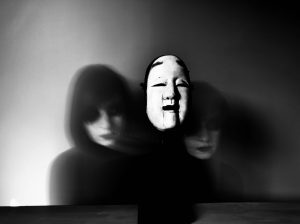
Numerous themes are covered in the movie, such as identity, duality, the nature of reality, and the self-other relationship. Different facets of the human psyche are represented by the characters Alma and Elisabet, who are thought to be reflections of one another. Numerous symbols can be found throughout the movie, including Elisabet’s masks and the double image that keeps appearing. The themes of identity and the disintegration of the self are explored through the use of these symbols. Additionally, it has been interpreted as a Freudian exploration of the unconscious mind. It is believed that the filmmaker’s own psyche is projected into the roles of Elisabet and Alma.
Some additional insights about Persona
- The movie’s surreal and mysterious atmosphere was enhanced by the black and white photography.
- The film is often mentioned as a precursor to postmodern cinema.
- It has been seen in many different contexts, such as a feminist film, a film about the nature of art, or a film concerning the perils of delusion.
 Other Notable Films Seemingly Influenced by Psychoanalysis
- The Shining (1988), The Stephen King’s novel adapted by Stanley Kubrick. It is a terrifying look at loneliness, insanity, and the power of the mind.
- David Fincher’s darkly comedic film Fight Club (1999) delves into themes of consumerism, masculinity, and the search for purpose in life.
- The psychological thriller Black Swan (2010) by Darren Aronofsky delves into themes of obsession, perfectionism, and the shadowy side of the creative process.
 Philosopher and author Albert Camus, as well as psychoanalyst Sigmund Freud, were known as two original thinkers. Though seemingly disparate, their works intersect at intriguing points, offering a rich tapestry for exploration. This blog explores the possible links between the psychoanalytic lens and Camus’ absurdist philosophy.
 The Myth of Sisyphus
  Totem and Taboo
 External and Internal Absurdity of Existence
 The ubiquitous and frequently crippling emotion of anxiety is a complicated phenomenon that has long fascinated scientists, philosophers, and psychologists. The symptoms of anxiety range from physical symptoms like rapid heartbeat, sweating, change in skin tone, trembling, shortness of breath, and muscle tension. Sometimes anxiety blurred vision may occur. Psychological symptoms of anxiety may include constant worry, seemingly irrational fears, anxiety panic attacks, catastrophic thinking, irritability, and social withdrawal. It is worth adding that those two lists are non-exhaustive, symptoms depend on the individual and the context.
  Cinematic Anxiety: Revealing the Monster
 Literary Characters as Anxiety’s Protagonists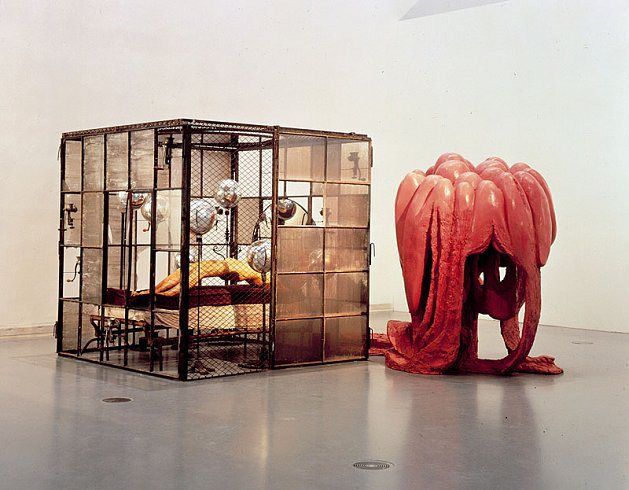
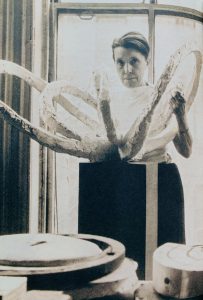 Renowned for her honest and unvarnished examination of the human psyche, Louise Bourgeois was a titan of the 20th-century art scene. As Donald Kuspit says in his essay about Bourgeois: “She was one of the great articulators of the core problems of modernity: psychic survival.” Her creation(s) is proof of the ability of art to be a working-through medium; it is frequently distinguished by its visceral intensity and symbolic depth.
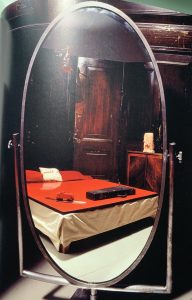 Red Room (Parents) (detail) 1994
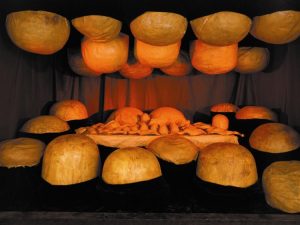 “The Destruction of the Father,” a powerful and visceral examination of Louise Bourgeois’s complicated relationship with her father, was published in 1974. Her rage, bitterness, and desire for vengeance are clearly depicted in this piece. Plaster, fabric, wood, and metal are among the disorganised materials that come together to form a hideous, broken figure. By deconstructing the paternal authority figure symbolically, this work releases the pain and betrayal she felt in a cathartic way.
 Bourgeois’ iconic spider sculptures, often referred to as “Maman,” are perhaps the most recognizable and enigmatic works in her oeuvre. These monumental figures, characterized by their imposing size and intricate web-like structures, have been interpreted in various ways.
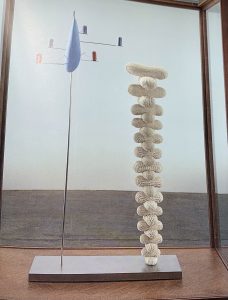 Conscious of Unconscious Sculpture (2008)
 What “haunts” are not the spirits of our ancestors in the literal sense. Sometimes, an intergenerational message is present with no way towards verbalisation, creating a sort of gap that can be painfully felt. A psychoanalyst, Galit Atlas, in her book „Emotional Inheritance,” talks about intergenerational secrets and unprocessed experiences that often don’t have a specific voice or image in our minds but still come rushing at us. We may carry within us the losses and traumas of our grandparents or parents that they never had the opportunity to fully articulate. We can feel these traumas, even if we are not consciously aware of them. Traumas that generations of our relatives have gone through can turn into nameless horrors, and untold stories are re-enacted again and again. Psychoanalysts Torok and Nichols call this phenomenon the buried speech of a parent, “a memory that was buried without a legal burial place.” This unknown phantom returns from the unconscious to ‘haunt’ its ‘host’ and may lead to phobias, compulsions, obsessions, or other similar issues specific to the individual. Its effect can persist through several generations and sometimes determine the fate of an entire family line. This segment of Reality is untellable and therefore inaccessible to gradual assimilative psychoanalytic work. This, in turn, creates a space in the ego where ‘workings’ through and mourning are not happening. Instead, the person may go through periodic states of mania or depression and create a ‘fantasmic’ identity to mask real suffering.
  Does leaving your country to start a new life elsewhere mean abandoning the legacy of your ancestors? Not necessarily. A psychoanalyst and linguist, Julia Kristeva, engages with the topic of being a foreigner in her work “Strangers to Ourselves.” Her own experience of displacement and adaptation, as a Bulgarian immigrant in France, informs her work on the complexities of belonging and otherness. Kristeva explores the figure of the foreigner as both a source of fear and fascination. She argues that foreigners disrupt societal norms and can reveal hidden anxieties within a culture. She writes: “The foreigner comes in when the consciousness of my difference arises, and disappears when we all acknowledge ourselves as foreigners, unamable to bonds and communities.” Kristeva emphasises the constant negation between belonging and alienation. She writes: “Not belonging to any place, any time, any love. A lost origin, the impossibility of taking root, a rummaging memory, the present in abeyance. The space of the foreigner is a moving train, a plane in flight, the very transition that precludes stopping.” Kristeva describes the human condition as specific to a foreigner but also a human being as such. We exist as a split subject that is incoherently divided and fractured. This split is not a psychological flaw but a fundamental condition of human beings. The notion that we can achieve balance and consistency in our lives or discover our true selves is an illusion propagated mainly by the self-help industry and much of the Holywood productions.
 Language connects us to our ancestors through its development, the preservation of cultural heritage, and genetic links. All languages return to earlier languages and adapt over time through sound changes, borrowing, and cultural exchange. Our ancestors passed on stories, songs, and customs through spoken language, thus preserving their knowledge and values. Family names, regional dialects, and even heritage can provide clues to the origins and migrations of our ancestors. Although many ancient languages have been lost, studying language families and historical linguistics helps us understand how we are connected to those who came before us. Psychoanalyst Sabina Spielrein wondered about the origin of language, reminding us that apart from verbal language, humans have rhythmic and melodic language, gestural language, and the language of the act. The languages based on sound predominate as means of communication and tend to be considered social languages. Spielrein emphasises that people become social beings primarily by using verbal language; however, genetically, verbal language is preceded by other forms of language. Initially, a child expresses their state through the different rhythms, tones, and intensities of their cries through a primitive melodic language. Spielrein wonders if it was an adult who invented a language or a child. She says: “The ancestor sleeps within the child and the child within the ancestor. If the adult really invented the language, he created it in its earliest origins out of the childlike stage of his psyche.” According to Spielrein, this could mean that the language is created in the subconscious, which would take us back to the experiences and processes of the infantile thoughts, which, in turn, would refer to the experience of our ancestors. It is worth remembering that language is complex, making it challenging to pinpoint a single origin of development, as it is in most things in this world.
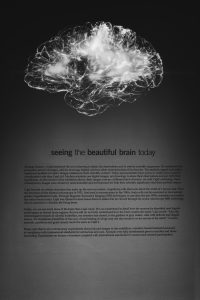 The brain is mysterious. We know only a portion of what there is to know about the brain, or the cosmos, for that matter. Perhaps, for that reason, we keep producing original and amusing ideas about both.
 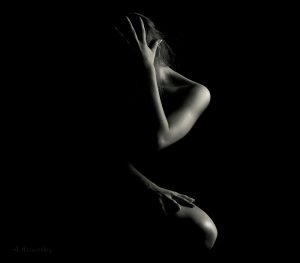 Skin is a responsive tactile boundary between self and other and the inside and outside of the individual. Skin is vital to survival, it is the place where two can meet. We often refer to the quality of skin’s symbolic containment or permeability: one is thinskinned or thickskinned. The irritating facts of life go “under one’s skin”; one does the essential or compromising thing to “save one’s skin”.
 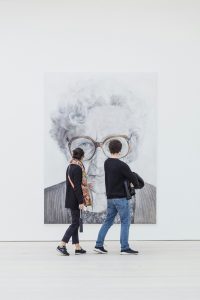 The eye receives and emits light, looks in and out, and is a window to the soul and the world. It can see too much or nothing at all. The eye illuminates, stares, understands, expresses, and protects. We can truly feel known by the way another’s eyes take us in, we can feel despair and sorrow at being “unseen.”
  Sounds, the movement of waves and wind noise in nature, and the sounds of a city travel inward through the complex labyrinth of the human ear. It is a direct reversal of Plato’s theory of sight as a projection of fire outward. The ear collects these waves in its cartilaginous pinna, directs them along spiral coils formed by the shape of the vibrating sound, and stimulates the eardrum to send the waves through three of the hardest and tiniest bones in the body – the hammer, anvil, and stirrup. These bones amplify air pressure in the Eustachian tube, which exerts pressure on the fluid in the innermost chamber, the snail-shaped cochlea. Sound perception is then transmitted to the auditory cortex via acoustic nerves in tiny hairs suspended in the fluid. Each hair corresponds to a different frequency. Because the inner chamber is only filled with fluid as animals evolved from aquatic to land animals, we can better understand the ear’s other vital function, which was to maintain our sense of balance after we lost the support of seawater.
 One of the oldest representations of a house is a little ceramic Chinese house from around 2000 years ago (ca.25-220 C.E). Its rudimentary windows and door convey the essence of a house as containment and shelter. A house is one embodiment of home; “home is where the heart is”. A feeling state of belonging, contentment and safety. Physically, our earliest home is the maternal womb in which we are gestated. Animals instinctively make their homes in nests, burrows in the earth, the hollows of trees, caves and clefts; many first homes of humans were intimate, encompassing, womb-like structures. All over the world cave drawings attest to our primordial presence.
 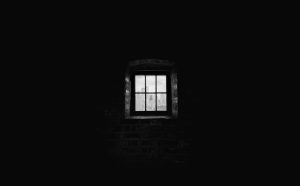 An essential part of a home is a window. It is a transparent threshold. It is an opening in a wall that lets in air, moonlight, sunlight, the colours of the world, and the dark of the night. The window is where inside and outside meet bringing together two worlds and their elements. Eyes have been called the windows of the soul. The word window is derived from the old Icelandic “vindr” wind and “auga” eye. The wind-eye was originally a hole in the wall protected by branches or a curtain exposed to the wind. Over the centuries the hole in the wall was screen by a rice paper, marble or thin panes of mica as a substitute for a glass. Eventually, being able to open and close, windows contributed to regulating heat and light and acquired the meaning of an interval of time in which something can occur.
 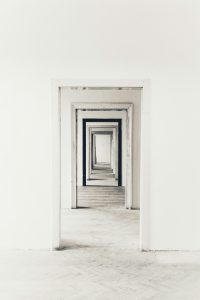 Doors can stand between here and there, between known and unknown. At the psychological level, gates are found between the inner and outer worlds, between sleeping and waking. So gates are the point of transition from one world to another. A mother’s body is the gateway opening to this world, the tomb, the gateway to what comes after death. In ancient Egipt, a doorway in the tomb was built to allow free passage- in and out to the soul. In our everyday life gates and doors are there to protect the house and the life of the family. The gate-doorway can be a numinous and dangerous place, rich in rituals and superstitions. Offerings and prayers are made, and shoes are removed before entering. One must step carefully over a threshold, usually right foot first, and should not sneeze, linger, or sit. On the other hand, sometimes doors and gates must be opened to release what is too confined inside. For example in folklore of the British Isles, house doors must be opened when someone dies to ease the passage of the soul.
 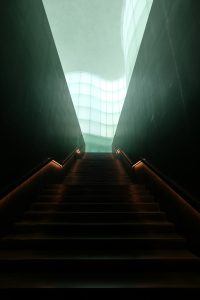 A stairway leads one up or down. The etymology of the word drawing on Old English words “stigan”- to climb and “staeger”- riser, suggests that stairs are primarily perceived as going up rather than both directions. This furnishes a symbol for ascents in slow stages and transitions through difficult steps. We see this externally in the stepped pyramids of ancient Egipt whose stairways provided a transitional zone between life and death. But staircases not only ascend, they also go down. In myths and fairytales or dreams the staircases descend into realms of mystery, magic, treasure, and imagination. Psychoanalysis taught us to search for our own descents for meaning. Freud used the French phrase ‘esprit d’escalier’ (wit of the staircase) to refer to repartee(*1)that occurs to us as we depart after an argument. The gain of creative wit by reclaiming our lower nature through psychoanalysis led Freud to reject what he considers the pretences of sublimation(*2).

 White evokes pristine, monotone landscapes. The polar whiteout erases even shadows, eliminates the horizons and deceives our perception of depth and scale. White also plays between the opposites. It is a merging of fire and ice, heat and frigid cold. The Snow Queen of the North is captivatingly beautiful and wintry, the pallid vampire bloodless in its passion. White receives the projection of all or nothing. The psychologist Rudolf Arnheim observed that w
 If red is the music to eyes then red would be the sound of trumpets. Red is evoked in humans by radiating energy of specific wavelengths which increase muscle tone, blood pressure and breath rate. These effects occur also in blind humans and animals, so red is not purely an experience of the eye but something more like a bath. Symbolically, red is the colour of life. Its meaning relates to the human experience of blood and fire. In primitive thinking, blood was life. If blood left the body it took life with it. At the same time, the red flow of blood was a danger signal. The red fire was our comfort and protection, but, out of control, a threat of annihilation. Red attracts us conveying vitality, warmth and comfort but also warns of danger, calls for attention, and says ‘stop’. Red tells the story of a judge (Jean-Louis Trintignant) who becomes embroiled in a love triangle with a woman (Irène Jacob) and a man (Daniel Olbrychski). He is forced to confront his own prejudices and tries to find acceptance from people from other social classes. The characters in this movie forge bonds even though they have little in common. The plot tells stories of people who are connected in the most random and surprising ways.