Categories
Uncategorized

Lessons from Radical Psychiatry Movements

The field of psychiatry and care for individuals with special needs has been profoundly shaped by radical experiments and practices that challenged oppressive norms. At the recent FreePsy conference on psychoanalysis and radical psychiatry, held at the Wellcome Collection in London, the spotlight was on transformative movements like the Saint-Alban experiment, Kingsley Hall, and the Cooperativa Sociale in Trieste. These initiatives questioned traditional views on mental illness, neurodiversity, and care, offering innovative and humane alternatives to institutionalization. Their lessons continue to resonate today, urging a reimagining of how we approach mental health care, with a focus on inclusion and human dignity. Reflecting on these movements, I am reminded of other pioneering approaches like Ferdinand Deligny’s work with autistic children and the Open Dialogue approach in Finland, which similarly challenged conventional thinking and offered new care models. These ideas remain vital for reshaping modern institutions and practices in psychiatry.

Here is an overview of those movements and ideas as well as some takeaways for modern mental health care institutions.
The Saint Alban Psychiatric Experiment

During World War II, Saint-Alban Psychiatric Hospital became a pioneering site for institutional psychotherapy under Dr. François Tosquelles, a psychiatrist influenced by Marxism and psychoanalytic thought. At a time when psychiatric institutions dehumanised patients and reinforced rigid hierarchies, Saint-Alban introduced groundbreaking practices to foster equality and growth. 

Staff and patients rotated responsibilities, rejecting traditional power structures. Nurses and doctors abandoned uniforms to erase visible authority, and patients took on communal tasks, such as gardening and cooking. This approach sought to prevent institutional stagnation and foster collective participation.

Tosquelles and his colleagues explored how rigid family dynamics, especially within the nuclear family, could stifle individuality. They argued that such environments often contributed to the development of what society labelled as madness. By creating a space for free expression, Saint-Alban allowed patients to explore their individuality and enter the process of healing.
Ferdinand Deligny and Mapping Neurodiversity

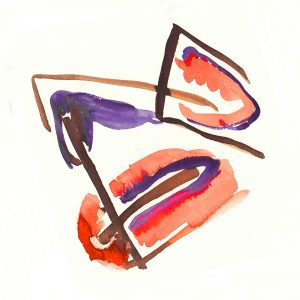
Ferdinand Deligny’s work with autistic children offered another radical departure from traditional approaches. In rural France, Deligny created an open, non-institutional space for children to live freely and explore their surroundings. He observed and documented the children’s movements, drawing intricate maps to understand their preferences and patterns. These maps highlighted the children’s autonomy and inner worlds, honouring their unique ways of being. Rather than imposing therapeutic goals, Deligny celebrated the individual differences in autistic children. His work resonated with ideas from Deleuze and Guattari, emphasising the importance of non-hierarchical and non-conforming approaches to care.

Kingsley Hall and the Anti-Psychiatry Movement

Kingsley Hall in London, established in the 1960s by R.D. Laing and David Cooper, became a central hub for the anti-psychiatry movement, which questioned the medicalisation of mental illness. Kingsley Hall provided a communal environment where individuals experiencing psychosis could explore their emotions without medication or coercion. Staff rejected traditional treatment methods, prioritising freedom of expression and mutual respect over control. Laing argued that oppressive family dynamics could contribute to mental distress. Kingsley Hall created a space for residents to express themselves without these constraints.

Though Kingsley Hall faced challenges and eventual closure, its philosophy continues to inspire more compassionate approaches to mental health care.

The Cooperativa Sociale in Trieste as A Model for Deinstitutionalisation

Franco Basaglia’s work in Trieste, Italy, spearheaded the deinstitutionalisation movement in the 1960s and 1970s. Basaglia’s reforms transformed mental health care, prioritising community integration over institutionalisation.

Basaglia led efforts to close psychiatric hospitals, culminating in Italy’s landmark Law 180 in 1978. This law mandated community-based care as an alternative to asylums. The Cooperativa Sociale encouraged patients to participate in work and social activities, promoting autonomy and dignity. Trieste’s model demonstrated that humane care could replace traditional institutions by integrating patients into everyday life.

The Open Dialogue Approach in Finland

Emerging in the 1980s in Western Lapland, Finland, the Open Dialogue approach represents a contemporary application of radical care principles. Open Dialogue involves patients, families, and social networks in care, emphasising open communication on diagnosis and hierarchy. Unlike traditional psychiatric models, Open Dialogue integrates patients into their communities and seeks to understand mental distress in context. This approach prioritises collaboration, reducing power dynamics, and fostering trust between patients and clinicians.

Open Dialogue has gained international recognition for its compassionate and effective treatment of psychosis and other mental health conditions.
Lessons for Modern Institutions

The common thread across these experiments is their rejection of coercion, celebration of individuality, and commitment to creating environments that empower rather than oppress. From Saint-Alban to Open Dialogue, these movements offer enduring lessons: 

  1. Reducing hierarchies fosters mutual respect and collaboration, creating spaces where both staff and patients can thrive.
  2. Rather than striving for normalisation, care should honour the unique ways individuals navigate the world.
  3. Whether through creative activities, dialogue, or unstructured movement, individuals have the freedom to express themselves authentically.
  4. Institutions must challenge societal and familial norms that contribute to mental distress.
  5. Care should occur within communities, not in isolation, to foster connection and dignity.

A Vision for the Future

The radical psychiatry movement and innovative approaches like those of Deligny, Laing, Basaglia, and Open Dialogue challenge us to rethink care. By prioritising humanity, creativity, and individuality, modern institutions can continue the legacy of these pioneers, ensuring that care is not just treatment but also liberation.
Categories
Uncategorized

Lindsay Pickett: On Expressing the Inexpressible

“The work of art is limited to an ‘acting out,’ not an understanding. If it were understood, the need to do the work would not exist anymore… Art is a ‘guaranty’ of sanity but not liberation. It comes back again and again.”


Louise Bourgeois 1992


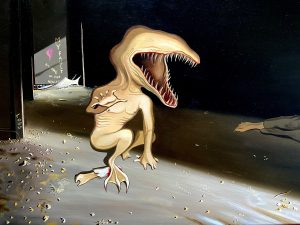
Art has long been a powerful medium for expressing the inexpressible, offering a visual language for personal experiences, unconscious fears, and unresolved emotions. It allows the artist—and, in turn, the viewer—to confront inner conflicts, traumas, and unresolved narratives that evade words. Lindsay Pickett’s paintings exemplify this process, blurring the line between the beautiful and the grotesque, the human and the monstrous. His surreal hybrid creatures, part-animal and part-human, serve as visual metaphors and containers for personal loss, emotional alienation, and existential dread.

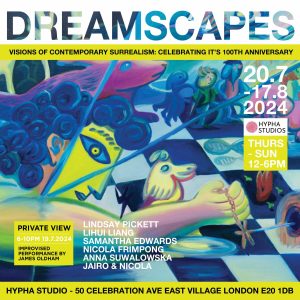
When I first encountered his work at the Dreamscapes exhibition by Hypha Studios in East Village Stratford, I was immediately drawn into these strange, unsettling worlds populated by uncanny beings—some with reptilian jaws and sinewy limbs, others bearing fragmented traces of human forms. Bright, dreamlike colours contrast darker elements, mirroring the tension between vitality and decay. In conversation, Lindsay shared how these hybrids emerged from artistic experimentation and the emotional challenges of his life—his struggle to navigate personal loss, a friendship that ended abruptly, and the journey of coming to terms with his neurodiversity.
Lindsay’s artistic evolution, from early cityscapes to surreal creatures, reflects his search for coherence amidst life’s unpredictableness. As he reveals in this interview, his work is a way of grappling with unresolved relationships, including the sense of abandonment and rejection he felt throughout his life. In his current series, these hybrid beings are both the product of imagination and a means of exploring deeper questions about identity, genetic manipulation, and the irreversible nature of trauma. Through these visual narratives, Lindsay invites us to reflect not only on the fragility of human connection but also on the ways in which we carry the scars of loss and transformation.

A: You’ve been painting and exhibiting your work for some time now. How has your career evolved over the years?

L: Yeah, I’ve been painting and having the odd show here and there. Things really changed for me in 2017 when I went back to adult education. I started working as a part-time tutor around then, too. But selling my work has always been difficult. I sell pieces “here and there,” but it’s not easy.

Painting started with cityscapes and playing with perspective, but then I began experimenting with hybrids—strange monsters and beasts. That idea has always been with me. However, I struggled with switching between different styles and themes. One of my tutors told me I needed to “settle on an area,” so I did. That’s when I began focussing on hybrid animals in a nonsensical, surreal manner.

A: You mentioned hybrids. Why are you drawn to painting them?

L: I’ve always been fascinated by hybrids. It probably comes from a blend of my influences—artists like Bosch, Bruegel, and the surrealists like Dalí, Tanguy, and Magritte. During my BA, I was often told my work reminded people of them, especially Bosch. I’d be looking at an etching plate and suddenly see shapes, creatures, or something unusual. That’s when I started getting comparisons to Dalí. At the time, I didn’t understand my work that well. I painted what came to me without much reasoning behind it.

A: How has your process evolved since then?

L: Now, it’s more about ideas and reasoning. I’ve come to understand why I paint what I paint. Immersing myself in exhibitions, connecting with other artists, and being part of different communities have really shaped my practice.

A: Who or what inspires you?

L: Surrealism, Romanticism, Sci-fi horror, and genetic engineering. I link these influences to broader issues like how toxic our planet is. During my MA, I started painting hybrid animals with a different perspective. It touches on themes of surrealism and genetic engineering—ideas that are relevant today. My work is also influenced by Alexis Rockman and his focus on the environment and pollution.

A: How does your work connect to artists like Bosch, often considered the precursor to surrealism?

L: Bosch’s work is about a consequence and the morals of religion, the choices we make, and the repercussions. In Bosch’s time, people really believed that if you committed wrongdoing, you would be tortured in Hell by monstrous hybrids of man and beast. I see my work in a similar way. My hybrid creatures are metaphors for the idea that we’re all hybrids in some sense—genetically, socially, and even emotionally. We’re all hybrids of our parents, after all. However, these hybrids are the consequences of genetic hybridisation gone wrong and the prices we pay for playing God with ‘Mother Nature’.

A: That’s a fascinating concept. Do you feel your personal experiences influence your work as well?

L: Definitely. I’ve felt like a misfit for much of my life, especially in school and even within my own family. I felt ignored and sidelined, and I lost many friends along the way. It took me a long time to understand that I’m neurodiverse, and now I’m proud of it. Society is still evolving in its understanding of neurodiversity, and that lack of awareness made me dislike working in school environments.

A: You’ve mentioned a series of paintings focused on hybrid animals. Can you tell me more about that?

L: Yes, I’m currently working on a series where these hybrid animals exist in their natural habitats but are seen as different and monstrous. One series, “Keep Out,” (see below), shows a hybrid creature that has become unrecognisable as human. In the paintings, a bitten-off hand appears, symbolising a part of myself that feels dead after losing a close friend. That loss inspired much of this work.

Title: Keep Out, Medium: Oil on linen, Size: 85cmx70cm

A: It sounds like you’re exploring some heavy emotional themes in your current work.

L: Yeah, my work is going through a “dark period.” Losing a friendship after a misunderstanding has deeply affected me, and I’ve been processing that loss for about two years now. It feels as painful as when I lost my father. However, I don’t connect the two events directly. My current paintings explore themes of loss, trauma, and abandonment. There’s a sense of dread in the work sometimes.

A: Is there a fear that you’ll run out of ideas?

L: Absolutely, that fear is there. But ideas keep coming. For example, I’ve been inspired by real-life creatures, like flesh-eating fish found in Brazil. There’s a lot of ugliness in my paintings, but that’s part of what I’m processing.

A: Amid all the darkness, do you think there’s room for beauty in your work?

L: Yes, for sure. Someone once said that some of the creatures in my work look like me. I’m not sure how they would know that, as they’ve never seen me naked [laughs], but maybe they’re right. Some of my new paintings feature creatures with ladylike shapes—legs, hips—but with the face of a hippo. There’s a strange beauty in dangerous creatures, like praying mantises or deep-sea creatures.

A: How do you approach creating these creatures?

L: Sometimes, I start drawing without knowing where it will go, but I tend to find images online to help develop my ideas. Some of the creatures in my paintings break free after killing the scientist who created them, seeking revenge for what was done to them. But the underlying theme is that it’s already too late—the experiment has been done, and the damage can’t be undone. Much like my relationship with that friend. Some things remain unresolved, and you can’t go back to change them.

Lindsay Pickett’s art lingers in the space between the familiar and the strange, balancing surreal forms with emotional depth. His hybrid creatures are unsettling, yet there is something undeniably human about them. In their awkward shapes and strange anatomies, they seem to echo the emotional contradictions we carry—our longing for connection alongside the fear of rejection, the inevitability of change, and the scars left by loss. These creatures, in many ways, become metaphors for the hybrid nature of identity itself—how we are shaped not just by genetics but by relationships, experiences, and the fragments of those we encounter along the way.

Through his paintings, Lindsay offers a space to reflect on what it means to live with unresolved emotions. His work does not aim to resolve or fix these contradictions but rather invites us to sit with them. Like the creatures that populate his canvases, some experiences—especially those involving loss—remain unchangeable, as reminders of what has been and cannot be undone. Yet within this darkness, Lindsay finds moments of beauty—whether in the elegance of a praying mantis or the strange allure of deep-sea creatures.

Ultimately, his art encourages us to confront the ambiguity of life. Some things, like broken friendships, can’t be repaired, and certain aspects of ourselves may never fully find resolution. But perhaps, as Lindsay’s paintings suggest, there is still meaning to be found in these fragments—in embracing the hybrid nature of our own emotional landscapes, where beauty and monstrosity coexist.

To see more of Lindsay’s work, go to:

https://lindsaypickett.co.uk/

https://www.instagram.com/lindsaypickettart/?hl=en